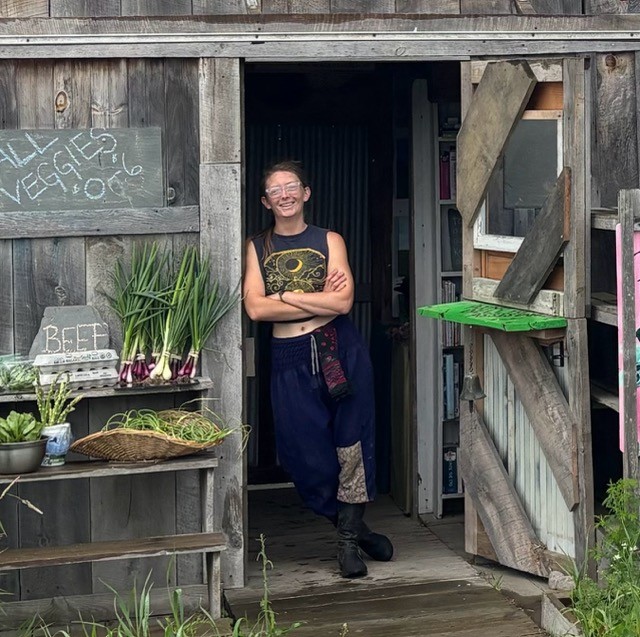
Please describe your farm operation/involvement in agriculture
I am the manager of a second-generation farm, learning from and with the land as we weave our dreams together. We're a small-scale agroecology operation, prioritizing the restoration of endangered species through regenerative agriculture. We're quite diversified, with four types of livestock, greenhouses, gardens, a lending library and several micro-ecosystems. We intentionally work within the gift economy and through practices of neighboring, creating strong community ties and ensuring no one is left behind or hungry, regardless of financial status.
Tell us about your journey in the agricultural industry. How did you get involved, build your business, etc.?
I grew up farming under the tutelage of the land and my parents. In 2016, I launched a small seed potato business, Milkweed Tussock Tubers, that prioritized climate resiliency and rare spuds. In 2023, when my parents were ready to retire from their own farm, Bittersweet Farm, I became manager and combined the two operations. My educational background is in restoration ecology, my passion is endangered species and my family focuses on neighboring and culture work. In 2024, I made the pivot to prioritize agriculture and ecological restoration outside the market economy as much as possible. These days, when I'm not planting taters, harvesting Sweet Annie for the sheep or participating in neighborhood butchering events, I'm sharing tales and philosophies of the work through our Substack blog: substack.com/@bittersweetmilkweedfarm.
How does your work intersect with your identity?
In embracing myself as a gender non-conforming queer, I extend such fluidity to my understanding of farming; agriculture, just like ecology and just like personal identities, is diverse. This thinking opens the door to exploration of how farming can become care work - who benefits from agroecology, versus who benefits from industrial ag? What happens to unsold or uneaten food? How does the current socioeconomic system create starvation situations and food apartheid? Who are the most impacted? Can queer agroecology change things? Is the queer community more likely to work outside the box? Can we prioritize the nourishment - both physical and emotional - of marginalized populations by gifting food, growing together, decommodifying agricultural education and breaking down barriers that prevent access to food sovereignty? Understanding the network of harm created by corporate capitalism is critical to then implementing new ways of being, informed by the multi-layered, intersecting identities of, in part, the queer community.
What do you hope the future of farming will look like for the next generations?
Agriculture must become decentralized and prioritized on smaller, community-based scales. I look forward to a future where farmers of all backgrounds, ages and abilities can grow food directly for themselves and their neighbors, where skill sets like fiber weaving, seedkeeping, fermentation, composting and cheese-making become both common and celebrated. Food sovereignty will become the standard, because we've reclaimed power from corporations and governmental entities. And to survive the climate crisis we are in, this must be done in partnership with our non-human relatives. Bean blossoms must nourish hummingbirds, even as beans nourish children. Ground-nesting birds must be included in planting schedules. Grazing systems must be rotated in ways that rejuvenate soils and native herbs. The future of agriculture that restores our planetary and personal health is one that celebrates the intersectionality of all, respects the past, and moves forward with a hundred-year plan in mind.
What advice do you have for LGBTQ+ individuals looking to enter agriculture or struggling to find their place?
Lean into your knowing. We live in a socioeconomic system that values neither small agroecology nor queerness. You will feel immense pressure to toe the line, to rake in the dough and to “find a ‘real job’” - take a step back and truly examine which directions serve your dreams, your spirit and your future. There is no shame in making the path while walking, even if it feels lonesome. Because for the record, next to that path you're creating are the myriad paths the rest of us are laying down. We are with you. We've always been here, and we always will.


